
Health
Emerado Volunteer Fire Department extinguishes 2-acre fire
By Amina El-Amin
Advertisement · Why this ad?
Chloe studied Public Health at the University of North Dakota and transitioned into journalism to advocate for community health issues. With 5 years of experience writing for local health publications, she brings an informed perspective to public health reporting.
More from Chloe →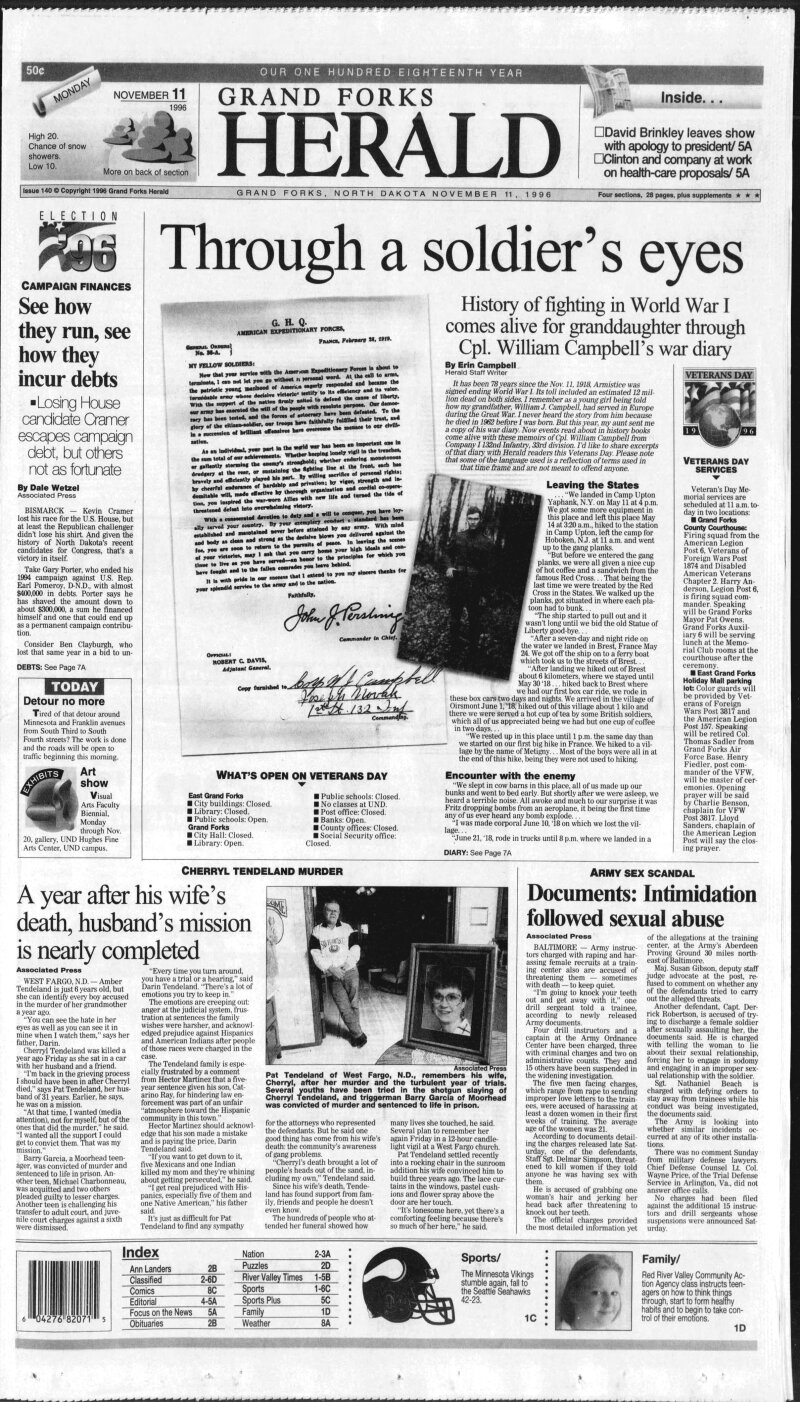
The scent of damp earth and the echo of distant explosions – these are the sensations that leap from the pages of a diary, penned nearly a century ago by a Larimore soldier. Cpl. William J. Campbell’s wartime memoirs, recently shared with his granddaughter, Erin Campbell, offer a visceral glimpse into the brutal realities of World War I, a conflict that claimed the lives of millions and reshaped the world. It's a story that resonates deeply, especially as we mark the 126th anniversary of Armistice Day, November 11, 1918, the day the guns finally fell silent after four years of devastating warfare. Campbell’s words, preserved in ink, bring to life the sacrifices made by American soldiers and offer a poignant connection to our own community’s history.
William J. Campbell, a man Erin Campbell never knew, served with Company I, 132nd Infantry, 33rd Division. His granddaughter, also named Erin Campbell, discovered his diary this year, a gift from her aunt. The discovery provided a profound window into a family history previously shrouded in silence. “I remember as a young girl being told how my grandfather, William J. Campbell, had served in Europe during the Great War,” Erin Campbell wrote in the 1996 article for the Grand Forks Herald. “I never heard the story from him because he died in 1962 before I was born. But this year, my aunt sent me a copy of his war diary.” The diary, now a treasured family heirloom, reveals the daily struggles, fears, and moments of camaraderie experienced by a young soldier far from home. The timing of its discovery—on the 78th anniversary of Armistice Day—added a layer of solemn reflection to the experience.
Campbell’s diary entries, spanning from May 1918 to October 1918, detail his journey from Camp Upton in New York to the front lines of the Somme in France. The language used reflects the terminology of the era, a detail Erin Campbell noted in her introduction to the diary. While some terms might be jarring to modern ears, they serve as a direct link to the historical context of the war and the soldier’s perspective. The diary entries are a stark reminder of the immense human cost of conflict, with an estimated 12 million people lost on both sides of the war. The National Archives offers extensive resources on World War I, including casualty figures and historical context.
The early entries describe the arduous journey across the Atlantic, the initial experiences of landing in France, and the relentless marches through unfamiliar terrain. Campbell writes of receiving a hot cup of coffee and a sandwich from the Red Cross upon leaving the United States, a small act of kindness that marked the last taste of home for many soldiers. He recounts his first major hike in France, noting that “Most of the boys were all in at the end of this hike, being they were not used to hiking.” These early entries paint a picture of a young man thrust into a world far removed from his quiet life in Larimore, North Dakota. The State Historical Society of North Dakota provides valuable insights into the experiences of North Dakotans during World War I.
As Campbell’s diary progresses, the tone shifts to reflect the harsh realities of trench warfare. He describes being bombed from airplanes, capturing enemy prisoners, and enduring relentless artillery fire. The entry dated July 4, 1918, highlights a significant victory for the 33rd Division: “Our regiment with some good work captured 1,800 prisoners on this date.” However, this triumph was tempered by the constant threat of death and injury. Campbell’s description of his first time in no-man's land, “I sure found out,” reveals the fear and uncertainty that permeated the soldiers' daily lives. The U.S. Army website offers information about the 33rd Division's role in World War I.
The diary entries detail encounters with Allied forces, particularly the Australians, whom Campbell’s unit assisted during a fierce battle at Harboniers. He describes the relief felt by both sides, acknowledging the Australians’ desperate situation. “The Australian soldiers were very glad to see us come to give them aid as they sure were in a bad position.” The diary also records moments of camaraderie and shared hardship, like the opportunity to swim in a river after a particularly grueling period. These moments of respite offered a brief escape from the horrors of war, reminding the soldiers of the lives they hoped to return to.
One particularly harrowing entry recounts an observation post mission on Dead Man’s Hill, where Campbell and a fellow corporal were fired upon by German snipers. They were forced to take cover and navigate a perilous route through a network of tunnels dug by the Germans. The diary also details a gas attack on October 8, 1918, where the soldiers were exposed to gas for 24 hours, resulting in many casualties. Campbell’s words convey the sheer terror and suffering endured by those caught in the attack. The lasting impact of chemical warfare is documented at Environmental Protection Agency.
The final entries in Campbell’s diary are marked by a sense of exhaustion and despair. He recounts witnessing countless deaths and the constant threat of injury. One poignant quote encapsulates the soldiers' shared sentiment: “Many would cry out 'tell mother I will not come back.’” These words serve as a powerful reminder of the human cost of war and the profound grief experienced by those left behind. The experiences documented in Campbell’s diary are a testament to the resilience and courage of American soldiers during World War I.
Cpl. William Campbell’s story is more than just a historical account; it's a reflection of the sacrifices made by countless individuals from Larimore and surrounding communities during World War I. His diary offers a tangible connection to a past that shaped the identity of this region. The war’s impact extended beyond the battlefield, affecting families and communities back home, who anxiously awaited news of their loved ones. The war’s legacy continues to influence our understanding of conflict, international relations, and the importance of peace. The story also highlights the enduring power of family history and the importance of preserving these personal accounts for future generations. The strength of families facing adversity—like those left behind by soldiers—is a cornerstone of our community's values.
Reading Cpl. Campbell's diary stirs a profound sense of responsibility within me. It’s easy to read about historical events in textbooks, but to encounter the raw, unfiltered emotions of a young man facing unimaginable horrors is deeply affecting. It underscores the fragility of peace and the immense sacrifices made to protect our freedoms. The fact that his granddaughter discovered this hidden piece of their family history speaks to the importance of preserving these personal narratives—they are the threads that connect us to our past and inform our future.
What strikes me most is the quiet dignity with which Campbell describes his experiences. There’s no boastfulness, no glorification of war—only a matter-of-fact recounting of events that would forever alter his perspective on life. It makes me wonder about the untold stories of so many other soldiers, the silent burdens they carried long after returning home. The diary also prompts reflection on the importance of strong families and supportive communities—the bedrock upon which individuals can find strength and resilience in the face of adversity. The stability of a loving home, a committed marriage, and a faith-filled community are essential for weathering life’s storms.
As we commemorate Armistice Day, let us not only remember the fallen but also honor the courage and sacrifice of those who served. Let us also commit to fostering a culture of peace and understanding, working towards a future where such diaries are relics of a bygone era, rather than a roadmap for repeating past mistakes. The questions remain: How do we best honor the sacrifices made by those who served? How can we ensure that future generations understand the true cost of war? And how can we strengthen our communities to support those who have served and their families?
The legacy of Cpl. William J. Campbell and the sacrifices of all veterans should be honored and remembered. The Larimore community, along with the rest of the nation, will observe Veterans Day with ceremonies and events to pay tribute to those who have served. Local organizations, such as the American Legion and the Veterans of Foreign Wars, play a vital role in supporting veterans and their families. The North Dakota Department of Veterans Affairs provides resources and assistance to veterans in the state.
Erin Campbell’s article serves as a powerful reminder of the importance of preserving family history and sharing these stories with future generations. The Grand Forks Herald’s decision to publish Campbell’s diary excerpts ensured that his experiences would not be forgotten. The story also highlights the value of local journalism in connecting communities to their history and celebrating the contributions of ordinary citizens. The Larimore school district can use this story as a valuable teaching tool, bringing history to life for students and fostering a deeper appreciation for the sacrifices made by those who served.
Cpl. William Campbell's diary is a precious window into a pivotal moment in history. It serves as a poignant reminder of the human cost of war and the enduring importance of peace. As we reflect on his words, let us recommit ourselves to honoring the sacrifices of all veterans and working towards a future where such tragedies are never repeated. The story also underscores the importance of strong families and supportive communities—the cornerstones of a resilient and thriving society. The commitment to traditional values—faith, family, and community—remains essential for navigating the challenges of the 21st century. Larimore Day School serves as a vital resource for families in the community.
The discovery of this diary is a gift, not just to the Campbell family, but to the entire community of Larimore. It’s a reminder that history isn’t just something that happens “out there”—it’s woven into the fabric of our lives, passed down through generations. It is a call to listen to the stories of those who came before us, to learn from their experiences, and to build a better future for all.
By Amina El-Amin

By Clara Jensen

By Lydia Smallwood

By Lydia Smallwood