
Technology
Engineering firms are meeting unprecedented regional infrastructure growth demand
By David Ortiz
Advertisement · Why this ad?
Jessica Rourke is a proud graduate of Minot State University and has spent 7 years covering educational news in North Dakota. Her work often highlights innovative teaching practices and community support for local schools.
More from Jessica →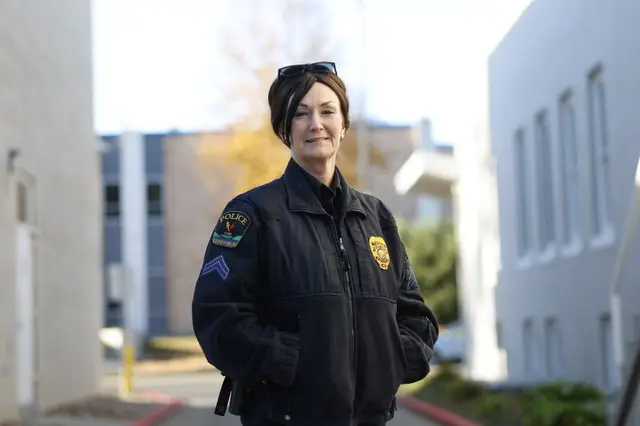
Based on facts, either observed and verified firsthand by the reporter, or reported and verified from knowledgeable sources.
GRAND FORKS — For people who work with unsheltered and unhoused people, urgency is key — even on the warmest, sunniest day of the year. But in North Dakota, as winter temperatures fall below freezing, everything becomes a crisis-level emergency.
When local shelters are full on the coldest nights, Grand Forks Police Cpl. April Prock says the police department first tries to locate an individual’s family or shelters in other cities and states that could take them. If those efforts fail, the police department has limited funds to put people up in hotels. When the hotels are full, Prock has been known to take people to 24-hour truck stops for a few hours to get out of the cold and to get something warm to eat. And as a desperate last measure, the police department has at times opened its entryway to anyone who needs a place to stay.
“That is the last resort — who wants to spend the night in the PD anyway? — but it’s heated,” said Prock, the department’s mental health and housing liaison. “We understand that’s not ideal, but anything will work to save a life.”
Northlands Rescue Mission gets new kitchen manager
Gov. Walz marks Minnesota veteran homelessness reaching 'functional zero' Oct 13 Local nonprofits continue to discuss homelessness in Grand Forks Aug 19 However, as the number of homeless people in the community continues to rise, a good day means keeping up, not getting ahead. Despite various attempts to address the situation in recent years, Prock doesn’t know what an effective long-term solution will look like.
“I’ve seen a lot of influx,” she said. “Whether people end up staying or they're just passing through, I don’t have any concrete data. There’s no way to track anything at the police department numbers-wise, but I just know from how busy I am versus past years that we have a lot of people coming through the area.”
Grand Forks is not unique — the number of people who are homeless or experiencing severe mental health challenges is on the rise nearly everywhere, and the reasons driving the trend are varied and complicated, Prock said.
Prock has been the GFPD’s mental health and housing liaison for about five years. In that time, she has seen a noticeable increase in people arriving from outside the area, from states such as California, Florida, Texas and Minnesota. In her experience, they tend to be drawn to the area at least in part by Grand Forks’ robust services for vulnerable people, such as the low-barrier shelter at The Nest on Fourth.
She has also seen an increase in what she characterizes as severe mental health challenges, such as psychosis, paranoia or schizophrenia, which she believes is driven at least partially by technology and AI.
“They just seem sicker,” she said. “More afflicted, and less able to manage those symptoms or seek help.”
In recent years, some Grand Forks City Council members have wondered if the city should reconsider funding certain resources and services for homeless people. Prock said emphatically that she believes that scaling back those services would be a mistake.
“I don’t know what a solution would be, but I know that limiting or reducing or eliminating resources would be horrific,” she said. "I would not support that. Our community needs resources. Resources aren’t just for individuals who are passing through — they’re for community members. … If those resources were taken away, we’d have bigger problems that we wouldn’t have any hope of helping.”
The council has recently curtailed funding for homeless prevention efforts. In September, the council voted to remove Community Service Grant funds from the 2027 budget. These funds have been used by nonprofits in recent years to fund homeless prevention services such as emergency shelter. In 2026, the council budgeted $159,135 for CSG funds.
In September, service providers asking the council to keep CSG funds in the budget said that removing them would cause “significant harm” to those who rely on them. Mayor Brandon Bochenski said at that time that removing the funds would give the city the opportunity to explore opportunities to fund service providers directly.
The 2027 budget still includes funding for The Nest and the Community Violence Intervention Center.
Prock said there are city-led efforts that have been helpful — the “anti-camping” ordinance, for one, passed in 2025 to prohibit sleeping on city sidewalks or in parks. That policy has made a significant difference in Prock’s work, although “in ways maybe that you wouldn’t expect,” she said.
Since that ordinance took effect on Aug. 1, 2025, officers have issued six citations — relatively few, Prock said. Instead of treating it as a punitive law, officers view the ordinance more as a tool that gives them the ability to approach people, identify them, introduce themselves, learn more about their situation and connect them with resources if desired.
“A lot of my colleagues were, I think, a little — a lot — leery about how that was going to affect the people that they work with negatively,” Prock said. “But I think over time, they’ve come to realize that, OK, we’re not throwing more people in jail because there’s a new ordinance. It actually helps me in my position to identify people. We have a reason to encounter them, we get their information, and we see how we can help.”
As a result, Prock is able to stay highly connected with homeless or transient people who might be in town.
As far as she knows, her role is unique in North Dakota — the nearest comparable law enforcement position that she knows of that focuses primarily on connecting homeless people with resources is in Minneapolis.
Technically, GFPD has two mental health and housing liaison positions, but the second is chronically unfilled. Prock is a uniformed police officer, but because her actual job is much closer to social work than traditional police work, it can be extremely difficult to recruit officers into the position.
As a result, her day-to-day job is focused much more on crisis management rather than providing long-term outreach.
“Unfortunately, these days, I’m kind of restricted to jumping into emergency or crisis situations, and doing what I can do with very limited time before jumping into the next,” she said. “I’m more of a bridge, or a middleman. These days it’s rare for me to have the time to follow a person or a situation from start to finish.”
There are people in town doing that long-term work — the field’s “unsung heroes,” Prock said — and she works extensively with such workers at organizations like the Community Agency Networking Association (CANA) and the Coordinated Access, Referral, Entry and Stabilization System (CARES).
For these outreach workers, the late autumn months running up to winter are boots-on-the-ground days. This time of year, CANA and CARES workers are creating and distributing cold-weather backpacks that include items such as sleeping bags, gloves and hand warmers.
Still, Prock said, anyone doing homelessness outreach in Grand Forks would agree that it’s not enough. There are certain things that the community excels at in homelessness outreach, such as acute crisis stabilization, Prock said. In other areas, the community falls short, particularly with wraparound services, or what she calls the "warm hand-off." She believes the current system isn't designed for long-term check-ins or support.
"Stabilization isn't the end. There's still a fight to fight, and still treatment to be done," she said. "Mental health, addiction issues, all of those are ongoing issues. They don't get cured. A lot of them r
Larimore, North Dakota
Technology
Saturday, November 14, 2026
6 min
By David Ortiz

By Ravi Patel

By Marcus Nguyen

By Marcus Nguyen